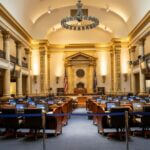
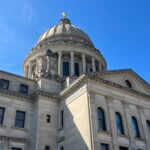
When House members meet this month for a special session to redraw state Supreme Court districts, they will convene in the Old Capitol building, where Mississippi lawmakers once implemented Jim Crow and voted to secede from the Union over slavery.
Black lawmakers told Mississippi Today that the optics of moving to dilute Black voting power in a building where officials previously voted to systemically disenfranchise Black citizens is tone deaf and insulting or, at best, symbolic.
The House chamber in the current Capitol is undergoing renovations, so House leaders chose to move to the Old Capitol Museum for the special session. The Senate still plans to meet in the current Capitol building.
Gov. Tate Reeves has called lawmakers back to Jackson for a special legislative session on May 20 to debate redrawing Mississippi’s three state Supreme Court districts. It’s unclear how lawmakers will redraw the districts, but several legislators predict they will be redrawn to make them whiter and dilute Black voting strength.
Some lawmakers, and the Trump administration, are calling for the Mississippi Legislature to go further in the special session and redraw congressional districts in an attempt to thwart Mississippi’s lone congressional Democrat, incumbent Rep. Bennie Thompson, even though primary elections have already been held for this year’s midterms.
Rep. Kabir Karriem, a Democrat from Columbus who leads the Legislative Black Caucus, said it was a horrible decision to debate redistricting in the Old Capitol, given the sordid history of decisions on race and voting rights made there.
“It’s a slap in the face to the 1.2 million African Americans in this state to be meeting in the place that established the 1890 Constitution that disenfranchised African Americans,” Karriem said.
A federal judge ruled last year that the state violated federal law with its Supreme Court districts. She determined that Black votes were unlawfully diluted and allowed the Legislature to redraw the districts this session.
The Legislature declined, but after the U.S. Supreme Court last week dismantled federal Voting Rights Act protections for minority voters, Reeves ordered lawmakers to return to Jackson to redraw the districts.
President Donald Trump is also pressuring the governor to add congressional redistricting to the special session agenda and essentially collapse the majority-Black 2nd Congressional District that Thompson represents.
Lawmakers met in the Old Capitol building from 1839 to 1903, according to the Mississippi Department of Archives and History, which is the state agency that oversees the building. The state constructed a new Capitol in 1903, where lawmakers currently meet.
In the Old Capitol, legislators voted in 1861 to secede from the Union. During Reconstruction after the Civil War, the state’s first Black lawmakers served in that building and elected the nation’s first Black people to serve in the U.S. Senate.
When Reconstruction ended, white supremacist delegates met in the building to craft the 1890 Constitution that stripped voting rights from Black citizens and imposed Jim Crow laws in the state. It wasn’t until Congress passed the Voting Rights Act of 1965 that the process of removing many of those provisions began. The U.S. Supreme Court has, in recent years, weakened the Voting Rights Act, and many observers say last week’s decision in a Louisiana redistricting case has all but nullified it.
With the passage of Jim Crow laws, the state implemented voter suppression tactics such as poll taxes, literacy tests, and grandfather clauses that prevented Black people from voting or holding elected office. It also ushered in decades of racial violence aimed at intimidating Black citizens from registering to vote.
But some say the decision by state House leaders to move the proceedings to the Old Capitol does not appear to be malicious. The current House chamber is unavailable for use, and there are limited options for alternative spaces for the 122 House members to convene.
Rep. John Faulkner, a Democrat from Holly Springs, said he believes there is no malicious intent in moving the proceedings to the old building, but he also believes using the old building is emblematic of current redistricting efforts.
“It’s ironic that it’s happened at a time like this, when we’re making decisions in this building that’s a reminder of our old past,” Faulkner said.
Rep. John Hines is a Democrat from Greenville and serves on the House Management Committee, which handles the logistics and business operations of the House. He said the committee had previously discussed meeting in another location for a special session.
To Hines, the location of the debate does not matter as much as the debate itself. If the House were to delay the renovations in the chamber or pay a private entity money to meet in another location, it would cost taxpayers more money, Hines said.
“We didn’t get elected to debate locations,” Hines said. “We got elected to make sure we take care of the rights of people. I’m more concerned about protecting the rights of historically marginalized people.”
It’s not unprecedented for lawmakers to meet outside the current Capitol.
When the Capitol building underwent massive renovations in the 1980s, lawmakers met in the old Central High School building. They also opened the 2009 regular session of the Legislature in the Old Capitol to commemorate repairs to the building from damage from Hurricane Katrina.