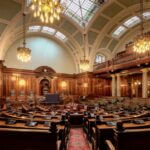
Jackson City Council members are taking extra steps to understand the city’s troubled budget following warnings of a sizable deficit.
The in-depth finance meetings began in March, and earlier this week, council members met to discuss the city’s less-than-stellar revenue figures, including going line-by-line to brainstorm ways to boost Jackson’s income.
“We haven’t done that in the middle of the year like we are now, but I think it’s a healthy process,” said Ward 1 Council Member Ashby Foote who has been in office since 2014.
First-term Mayor John Horhn and all seven council members, including two in their first term, took office in July. Since the council approved the first budget under Horhn in the fall, city officials knew it was possible Jackson could spend more money than it was poised to collect for the year beginning Oct. 1.
Jackson City Hall on Tuesday, July 19, 2023. Credit: Eric Shelton/Mississippi Today
But lacking final revenue figures from the previous fiscal year to gauge expectations while they wrote the budget for the new year, no one knew exactly how large a shortfall to anticipate in Jackson’s spending plan.
Where does the money come from?
All told, Jackson’s budget is more than $330 million. Most of the money includes grants from the state, the federal government and philanthropic groups; lawsuit settlement funds; and the city’s internet sales tax that is earmarked for roads and bridges.
Much of the budget is dedicated for specific uses – the city cannot repurpose the dollars.
The $135 million general fund is part of the $330 million, but the general fund has greater flexibility in spending. The general fund is made up of money from several sources, including the local share of sales tax collections; payments from parking tickets or other municipal court assessments; revenue from building, plumbing, electrical and gas permits; fire inspection permits; and revenue from Thalia Mara Hall and the Smith Robertson Museum.
A consultant previously estimated Jackson will bring in about $112 million for the general fund, which would be a $23 million deficit.
At Monday’s meeting, the chief administrative officer, chief financial officer and a budget analyst presented revenue figures for the first half of the budget year, through the end of March. If revenue trends hold, the city is likely to have the expected $23 million shortfall for the full fiscal year – and this means budget cuts are in order.
Since Jackson’s projected deficit is greater than 10%, Ward 2 Council Member Tina Clay said the city will need to advertise the revised budget in a newspaper, under state law.
Helping her colleagues
The finance committee chair, Clay said she quickly realized that council members weren’t understanding the city’s explanations for the projected budget gap.
“I hope you have a highlighter,” she said at the start of the meeting Monday. “If you don’t have a highlighter, we have some extra.”
Clay has spent weeks studying the budget, and she said she concluded the council initially approved an imbalanced plan because members did not ask the administration for context.
“The situation we’re in right now is because we didn’t work with all the numbers,” Clay said.
Jackson city government has a “strong mayor” system, in which the council has the final say on the budget but no formal control over the finance department, which falls under the mayor.
Clay said as a first step in discussing midyear finances, she needed to teach the other council members how to read documents produced by the city’s accounting system, Munis.
Clay explained that in Munis, positive numbers appear as negative numbers. Even more confusingly, a column in a spreadsheet itemizing current revenues – about $74 million – was titled “YTD (year to date) EXPENDED.” In this case, she explained, “expended” actually means “collected.”
Foote, a money manager in his day job, put his foot down.
“It shouldn’t say ‘expended,’” he said. “We’ve got to make sure the terminology is right.”
Ward 1 City Councilman Ashby Foote, right, listens as Mayor John Horhn discusses projected plans to rectify the city’s water issues during a town hall meeting held at City Hall, Monday, Feb. 16, 2026, in Jackson. Credit: Vickie D. King/Mississippi Today
Council members also learned that:
Jackson is on track to collect about $250,000 less in property taxes than the $68 million it initially budgeted for.
The city is struggling to collect fines and fees. During the first half of the year, it took in just 25% – rather than ideal, around 50% – of the more than $1.6 million it had anticipated for the full year.
Though not a significant money-maker, the city has collected only a third of its anticipated $330,000 in alcohol permits due to statewide warehouse shortages of alcohol.
Revenue from the city’s museums was down, Thalia Mara Hall had not brought in the anticipated funds and downtown’s Union Station had fewer tenants than expected.
Out of an anticipated $100,000 from parking meters, Jackson had collected $0.
WLBT reported that last year, the parking meter contract generated nearly $450,000 but the city did not receive the money until after the second half of the year.
Not all doom and gloom
But there were some bright spots.
Chief Administrative Officer Pieter Teeuwissen said the city’s golf course is making more money, and he believes that is because of the digital payment system. He said the city is considering opening the course on Mondays when other courses in the metro area are closed, and increasing the greens fees by $5. They currently start at $12.
Council members also discussed an “amnesty day” to allow people to pay municipal court fines without penalties and how to get more tenants into city-owned properties like Union Station.
Teeuwissen also said the city is exploring hiring a law firm to increase its debt collection rate on fines and fees.
“You’re doing what we really need you to do as council members,” he said. “So the administration and the council are on the same page, talking this language.”