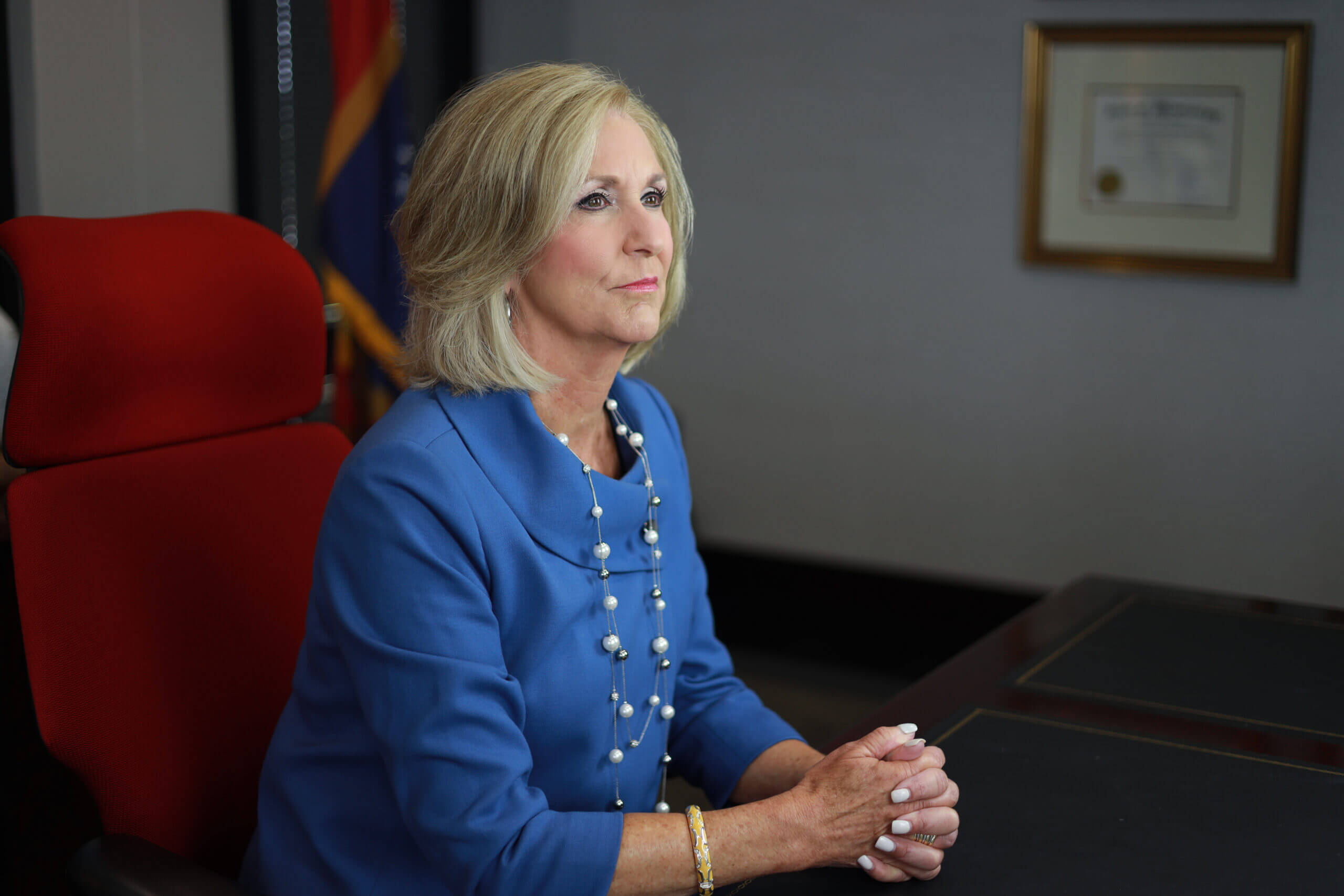
AG Lynn Fitch could have ‘virtually unlimited latitude’ to set how Mississippi’s $189 million Meta settlement can be spent
By Michael Goldberg and Allen Siegler | Originally published by Mississippi Today
As Mississippi Attorney General Lynn Fitch prepares a plan for how Mississippi can spend $189 million of national Meta lawsuit funds, legal experts told Mississippi Today that the settlement raises questions about whether the money will be used to directly address children’s mental health.
Fitch is drafting the plan as Meta, the corporation that runs Facebook and Instagram, prepares to pay billions of dollars to states after attorneys general accused the company of endangering children across the country with their social media platforms. The settlement agreement the lawyers came to doesn’t require Mississippi to use the money for any specific purpose, instead instructing the attorney general to set the parameters in a final consent decree filing.
Fitch’s office said lawyers for the state would file that plan in Hinds Chancery Court this month. Legal experts, mental health advocates and state lawmakers told Mississippi Today that Fitch’s plan could impact the health of children in the state for years to come.
A landmark settlement
The final consent decree is coming after 47 states, the District of Columbia and U.S. territories reached a historic $17 billion settlement in late August with Meta. Mississippi’s share of the money could go up to $270 million if the tech companies Snap, TikTok and YouTube also agree to settlements with the attorneys general.
The settlement follows a series of years-long parallel lawsuits and joint federal complaints against Meta, accusing the company of turning its social media platforms Instagram and Facebook into “addiction machines,” targeting children during vulnerable life stages. This settlement resolves those cases, including Mississippi’s lawsuit, with payments to each of the states and establishing new safety standards Meta must implement on Facebook and Instagram. Some social media experts have questioned whether the standards will be effective.
But the agreement allows many states to determine how their share of the billions of dollars will be spent as Meta makes payments over 10 years, starting by the end of this month.
The national settlement offers suggestions for how states could spend the lawsuit money — such as improving youth crisis hotlines or funding outdoor activities. But those recommendations are non-binding.
Asked about the parameters she might set for spending the money, Fitch told Mississippi Today it would be spent to provide children with information to protect themselves from the harms of social media.
“The money will be used for our children,” Fitch said. “It will be geared specifically to protect our children (through) awareness, outreach, programs that involve them and give them the information to be protected.”
Fitch, a Republican, is running for governor and has touted her efforts to protect children from large technology companies. MaryAsa Lee, a spokesperson for Fitch, said the consent decree will follow the directions laid out in the global settlement.
Lee didn’t answer an additional emailed question about how the Hinds County consent decree will ensure the Meta money is spent to help Mississippi children. She said the lawsuit “was premised in part on the impact on children’s mental wellbeing and the settlement agreement her office helped to negotiate made that a priority.”
But no legal documents bind Mississippi’s Meta money to that priority yet. Matt Steffey, a Mississippi Christian University law professor, said the settlement does not include some of the restrictions that were tethered to the $430 million the state is receiving in opioid settlement money. Some of those funds can be spent on purposes unrelated to addiction, but the lawsuits against the drug companies that contributed to the overdose epidemic say the state must use most of it to address addiction.
By contrast, the Meta settlement says state attorneys general can use the money for any lawful purpose.
“That language gives the AG virtually unlimited latitude,” Steffey said.
Chris Murray, senior fellow at the Northeastern University Cybersecurity Research Center, said in an email that attorneys general including Fitch should be applauded for filing and investing resources in the lawsuit. The center’s research has repeatedly found platforms such as Instagram to be dangerous for kids, even after they’ve implemented safety features.
Mississippi continues to face a youth mental health crisis. Roughly 31,000 children in the state between the ages of 12 and 17 have seriously considered suicide, according to the National Alliance on Mental Illness in 2025. The alliance also found that Mississippi only has about one school psychologist for every 10,000 public school students.
“This settlement can be used to support the mental health of Mississippi kids — if the state doesn’t sweep the money into the general fund and use it to pay for politicians or potholes,” Murray said.
What role will state lawmakers play?
Although the national settlement assigns spending decisions to attorneys general such as Fitch, the Mississippi Constitution gives the Legislature authority to spend most public money. Lawmakers have asserted that authority with both tobacco and opioid settlement funds.
House Public Health Chairman Sam Creekmore, a Republican from New Albany, said he had a recent meeting scheduled with Fitch, and he planned to address the settlement with her then.
Creekmore declined to say what he would like to be included in the consent decree, but he said he hopes the money will support children’s mental health initiatives. Fitch’s office did not answer a question asking whether she has discussed the settlement with legislative leaders.
“Whatever money comes in from whatever settlement needs to address the reasons why we got the settlement to begin with,” Creekmore said.
Senate Public Health Chairman Hob Bryan, a Democrat from Amory, said the state Supreme Court has ruled that money recovered via settlements such as this one belong to the client, not the attorney. He cited the court’s 2007 ruling against the attorney general’s office, which stopped the AG’s office and a board it created from spending money recovered from a landmark tobacco settlement without legislative approval.
Bryan said he was concerned about managing the Meta money even if the Legislature has broad spending authority. He said that in the past, the state hasn’t spent pots of health funding in ways that complement each other.
“I just am extraordinarily concerned that this appears to be a one-off thing over here in a world unto itself, and it’s got no coordination with anything else,” Bryan said.
Even with settlement restrictions on national opioid funds, other states have found ways to use some of those lawsuit dollars for purposes unrelated to mitigating the crisis corporations catalyzed. Shelly Weizman, the associate director of Georgetown Law’s Center on Addiction and Public Policy, said that puts more of the onus on states to plan ahead for how the Meta money can be used effectively.
“Where does Mississippi want to be on this issue in five years, in 10 years?” Weizman said. “And what’s needed to accomplish that?”
Mississippi leaders finalized their plan to spend most of the state’s opioid settlement years after the state received its first payment. But in a rush to implement that plan, the state made mistakes and didn’t create opportunities for the Mississippians most harmed by the opioid epidemic to offer their wishes for the money.
Joy Hogge, former executive director of the Mississippi children’s mental health advocacy nonprofit Families As Allies, said in a text that the state’s opioid settlement management provides leaders with a clear lesson on how not to approach the Meta funds. She said the input of Mississippians directly harmed by the social media company is crucial.
“Funding decisions should always be guided by the people most impacted by the issue.”
This article was originally published by Mississippi Today and is republished here under a Creative Commons license.
Source: Original Article