Amid evaporating federal funding, the Mississippi Department of Education is getting a $136 million bump in funding to cover a $2,000 teacher pay raise and initiatives that aim to build on the state’s academic gains in reading.
Even though the agency asked for $3.35 billion, slightly higher than last year, lawmakers allotted the state Education Department $3.46 billion for the upcoming fiscal year.
The uptick is largely due to a pay raise, $100 million in total, for public school teachers. The Legislature, after months of haggling, landed on a permanent $2,000 increase to Mississippi teachers’ salaries, as well as raises for school attendance officers, school psychologists, occupational therapists and assistant teachers.
In addition to allocating $3.5 million for the Mississippi Teacher Residency Program, which aims to help staff school districts struggling with teacher retention and recruitment, lawmakers approved $14.6 million for many state Education Department classroom initiatives. This included extending in higher grades a literacy act that experts say helped boost the number of Mississippi fourth-graders scoring advanced or proficient on the National Assessment of Educational Progress and establishing a similar math program.
House Education Chairman Rob Roberson, a Republican from Starkville, said establishing those literacy and math initiatives were two of the most important things the Legislature did this year.
“The state of Mississippi has really moved head and shoulders above other states, and having these types of programs that back up our students and teachers to allow the kids to be proficient in these areas are probably the most important thing we can do to make sure they’re successful in the future,” he said.
The new adolescent literacy initiative, focused in fourth through eighth grades, builds on the 2013 Literacy-Based Promotion Act. This legislation established a third-grade reading gate and helped Mississippi gain national attention for improved reading proficiency.
However, national test data shows those reading gains aren’t sustained into higher grades.
Education officials and lawmakers said they hope spending $9 million to expand key features of the literacy program — adding assistant directors, regional coaches and literacy coaches to support teachers and comprehensive statewide professional development — will help students maintain their reading proficiency into middle and high school.
“Initiatives like these will keep their hunger for reading going, I hope,” said Rep. John Hines, a Democrat from Greenville.
The Mississippi Math Act, which creates a statewide math program modeled after the literacy initiative, will cost $3.48 million. That money will fund coaches’ salaries and travel, screeners and statewide training.
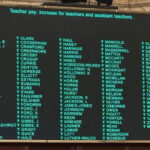
State representatives vote on a teacher pay raise bill in the Mississippi House chamber on Friday, March 6, 2026, at the Capitol in Jackson. Credit: Eric Shelton/Mississippi Today
The new program is in line with the agency’s push to help students become more prepared for the workforce.
“Math is not just a school subject,” said Sen. Nicole Boyd, a Republican from Oxford who championed the program in her chamber. “It’s a workforce issue, a college readiness issue and a competitive issue. If Mississippi wants to lead in jobs in the future, we have to build stronger math skills today. We cannot build a first-class work force on shaky math fundamentals.”
The agency also got $2.1 million to continue its new virtual teaching program, The Mississippi REACH Remote Synchronous Teaching Initiative, which puts educators on classroom screens throughout the state. The initiative is one of the agency’s attempts to respond to the teacher shortage affecting swaths of Mississippi schools.
The state’s early learning programs, recognized nationally for their success, continue to receive millions in support from the Legislature — $29 million for early learning collaboratives and $13 million for the state-invested pre-K program. Roberson said in the future he’d like to put more money toward these programs.
State Superintendent of Education Lance Evans told legislators in January that the agency is focused on spending directly on classroom education.
“The launch of these two new programs will be among MDE’s top priorities for the new school year,” Evans said in an emailed statement.
Mississippi First’s K-12 education policy researcher Grace Breazeale noted that the budget fully funds some classroom initiatives while cutting several small ticket items that had been consistently funded including tutoring platform Amplify, Teach for America and online education platform CanU University.
It’s important that the state continues to fully fund the student funding formula in light of federal pandemic relief funds drying up last year, she said.
“That has an impact on school budgets,” Breazeale said. “It makes it even more important for state funding to be dependable.”
The Mississippi Charter School Authorizer Board, which approves and oversees the state’s charter schools, got its full $1.4 million ask of the Legislature — a marginal $3,231 raise, due to slightly higher salary costs.