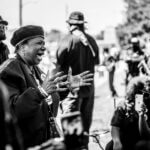
Civil rights veteran the Rev. Ed King who helped found the Mississippi Freedom Democratic Party has died
By Jerry Mitchell | Originally published by Mississippi Today
The Rev. Ed King, a white minister who challenged Mississippi’s dangerously segregated society in the 1960s and was one of the last living founders of the Mississippi Freedom Democratic Party, died in Jackson on the same day the nation celebrated its 250th birthday of freedom. He was 89.
“He truly heard Jesus’ commands for us: loving your neighbor, meting out justice, taking care of the least of these and loving your enemy,” recalled former Assistant Secretary of State Constance Slaughter-Harvey.
At the time she met King in 1964, she was a sophomore at Tougaloo College, a private historically Black college in Jackson, where he served as chaplain and a sponsor for civil rights meetings. He supported her and the movement over and over, she said.
“He was an inspiration, always encouraging, always welcoming,” said Joan Trumpauer Mulholland, the first white student to attend Tougaloo. “Everybody was always going by his house.”
King seemed like the least likely person to get involved in the movement. His great-grandfather fought with Confederate Gen. Robert E. Lee and generations of his remained committed to segregation
But as he neared adolescence, he began to realize things needed to change.
“By the time I was 10 or 12 in Vicksburg, I had realized that America had not figured out yet how to deal with our history of slavery and continuing racism,” he said in a 2018 interview with a University of Mississippi Medical Center publication.
He had previously attended Millsaps College. There, he began to take part in meetings at Tougaloo College and met Mississippi NAACP leader Medgar Evers, who encouraged him.
After studying in Boston, King, encouraged by Evers, returned to Mississippi and began working at Tougaloo, which served as a safe haven for activists. He helped organize sit-in protests and was repeatedly jailed for his activism.
In 1963, he was a candidate in the Freedom Vote, a mock election that showed Black Mississippians wanted to take part in the democratic process even as they still faced poll taxes and violence that prevented most of them from becoming registered voters. More than 83,000 Black Mississippians cast ballots in that mock election.
Aaron Henry, a Black pharmacist from Clarksdale, was the candidate for governor; King was the candidate for lieutenant governor.
The interracial ticket drew national attention.
“Ed King really provided a lot of the political know-how taught by the Mississippi Freedom Democratic Party,” said Leslie Burl McLemore, who served on the party’s first executive committee with King.
In 1964, Mississippi Freedom Democratic Party activists including King, Henry and Fannie Lou Hamer challenged Mississippi’s all-white delegation to the Democratic National Convention. Although they lost, their fight helped remake the Democratic Party.
Mississippi’s segregationist leaders liked to claim that the Civil Rights Movement was led by “outside agitators,” but the involvement of Mississippi natives such as King, Hamer and Hollis Watkins demonstrated that claim was a lie, said McLemore, a retired Jackson State University political scientist who served on the Jackson City Council from 1999 to 2009.
Getting involved in the movement in those days meant “you were putting your life on the line every day,” he said. “You and your family could be harassed. You could lose your job. Lots of people lost jobs because of their involvement in the movement.”
In hopes of waking up Christians in the early 1960s, King challenged racial segregation in churches. He and Evers drove Tougaloo students to all-white churches. In most cases, the churches turned them away.
“Confronting segregation on Sunday morning was one of the more radical things that Ed King was involved in that people don’t know about,” said Millsaps history professor Stephanie Rolph, author of “Resisting Equality: The Citizens’ Council, 1954-1989.”
On the same night that President John F. Kennedy spoke about the grandsons of slaves still not being free, King’s friend, Evers, was killed by an assassin’s bullet.
Six days later, King and Tougaloo professor John Salter were injured in a car crash that shattered King’s jaw and tore up the right side of his face. He required numerous surgeries over the next dozen years.
King suffered severe injuries again in a second collision in Canton. Activists believed both crashes were attempts to kill movement leaders.
Later on, King took a step back from that leadership, Rolph said. “He understood when it was right to let someone else lead.”
Instead, he served as an advocate and ally to the rising leaders in the movement, she said.
Throughout his life, King “sacrificed himself for the good of the cause,” Slaughter-Harvey said, “and that cause was justice and service and love.”
King was one of many plaintiffs in a lawsuit filed in 1977 charging the Mississippi Sovereignty Commission with illegal surveillance of citizens. The state-funded agency operated from 1956 to 1977, spying on civil rights activists and feeding information to law enforcement officers. In 1994, a federal judge established a procedure to release the commission files. An appeals court upheld that decision two years later, and King appealed to the U.S. Supreme Court, arguing that every person named in the files should have access to the documents before any public release. The high court declined to hear King’s appeal, and the files were later opened to the public.
King later worked for the University of Medical Center and co-wrote the 2014 book “Ed King’s Mississippi: Behind the Scenes of Freedom Summer” for University Press of Mississippi, which featured dozens of his never-before-published photos from the movement in Mississippi.
The book included an excerpt from a speech King gave at the University of Virginia in 2002, where he said an important part of the Civil Rights Movement was “to get the oppressed people to change their identity of themselves. They had to stand up and claim their freedom and claim their dignity.”
King said this was done by reminding people that they are children of God.
“We also had to … let America, let the rest of the nation, know that Black people weren’t just waiting to be saved by Washington, that they were standing up and demanding,” he said in the speech. “Now, that shocked America.”
Reena Evers-Everette, executive director of the Medgar & Myrlie Evers Institute, said King remained faithful to his friends and the movement. “He was such a loyal confidant and strategist with my father as well as a family friend. He continued fighting for civil rights for all of his life.”
This article was originally published by Mississippi Today and is republished here under a Creative Commons license.
Source: Original Article