‘Betrayal’ or ‘saving our country.’ Mississippi leaders react to Supreme Court voting rights decision
By Michael Goldberg and Taylor Vance | Originally published by Mississippi Today
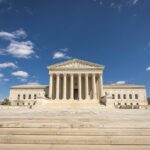
Mississippi politicians, advocates, civil rights leaders and legal experts reacted with either condemnation or celebration of the U.S. Supreme Court striking down Louisiana’s second majority Black congressional district on Wednesday.
The decision could open the door for states such as Mississippi to eliminate majority Black electoral districts.
The landmark Louisiana v. Callais decision places Mississippi and other Southern states at the center of a national partisan and racial political battle over redistricting. It was also a stinging decision for civil rights leaders in Mississippi, where racial discrimination and efforts to disenfranchise Black voters are central chapters in the state’s history.
“This is a betrayal of voters of color in Mississippi and Black voters in Mississippi,” said Charles Taylor, executive director of the Mississippi State Conference of the NAACP. “Mississippi has a rich history of suppressing the vote, and now the U.S. Supreme Court has decided to do the same. This is a step backwards, but we’re going to continue to fight, just as we did during Jim Crow, just as we did during the Civil Rights Era.”
The decision came after President Donald Trump touched off a nationwide redistricting battle to boost Republican chances in this year’s midterm elections.
It’s not clear whether the decision was issued early enough for some states, including Mississippi, to consider a new round of congressional redistricting ahead of the 2026 midterms, in which Republicans are trying to preserve thin majorities. But other states, such as Florida, are poised to redraw congressional maps to favor Republicans this cycle. Democratic-led states, such as California and Virginia, have also moved to redraw maps to net Democrats the potential to win additional seats.
In a statement to Mississippi Today, Gov. Tate Reeves said the decision “is a win for our Constitution and a tremendous win for our republic.”
“It was long past time to end racial redistricting,” Reeves said. “The United States will be better off because of it. Today’s decision reaffirms what we knew all along: that all Americans, regardless of race, are equal.”
In a separate statement on social media, Reeves likened the decision’s gravity to the Mississippi lawsuit that led to the Supreme Court in 2022 overturning the Roe v. Wade decision that had upheld abortion rights.
“First Dobbs. Now Callais. Just Mississippi and Louisiana down here saving our country!” Reeves wrote.
Days ago, Reeves called for lawmakers to create new state Supreme Court election maps in a special session of the Legislature. Reeves ordered the session to happen time-certain after any ruling in the Louisiana v. Callais case. It will be held on May 20.
Mississippi has already held party primaries for the 2026 congressional races, so it would be challenging for state lawmakers to craft new congressional maps and hold new special primaries before a November general election.
But some Republican politicians in Mississippi were already calling on Wednesday for the redrawing of the state’s congressional maps to thwart longtime Democratic U.S. Rep. Bennie Thompson, the lone Democratic member of the state’s congressional delegation. Thompson is also the only Black member of Congress representing Mississippi, which has the highest percentage of Black residents of any state.
State Auditor Shad White, a likely Republican candidate for governor in 2027, said he hoped state lawmakers would redraw Thompson’s district.
“This likely opens the door to redrawing Mississippi’s congressional districts,” White wrote on X. “Mississippi might no longer have a district drawn to protect Bennie Thompson.”
State Sen. Kevin Blackwell, a Republican from Southaven, said it is time to “erase” Thompson’s district.
Thompson did not immediately respond to a request for comment to his office.
In a statement to Mississippi Today, MaryAsa Lee, a spokesperson for Republican Attorney General Lynn Fitch, applauded the decision and urged the Supreme Court to take up its appeal in a legislative redistricting case that could further weaken the Voting Rights Act.
“We are pleased that the Court’s opinion offers useful clarity to states in drawing maps that comply with the Voting Rights Act and the 15th Amendment, and we are hopeful that based on this opinion, the Supreme Court will take up our pending direct appeal in SBEC v. NAACP,” Lee said.
Fitch’s office appealed a three-judge panel’s decision in the legislative redistricting case, where it asked the U.S. Supreme Court to rule that private citizens cannot file a redistricting lawsuit. Fitch’s office believes only the U.S. Department of Justice should be able to file such a suit.
There is no question that the landmark Voting Rights Act’s protections against discrimination in redistricting have been weakened. But it’s unclear if the provision, known as Section 2, would still have any teeth. It has served as the main way to challenge racially discriminatory election practices.
Mississippi Senate Minority Leader Senator Derrick Simmons, a Democrat from Greenville, said the decision represents a profound shift in how the nation interprets and protects the voting rights of minority communities.
“For decades, the Voting Rights Act has stood as one of the most important civil rights laws in our nation’s history—ensuring that communities of color have a meaningful opportunity to elect candidates of their choice,” Simmons said. “Today’s ruling raises serious concerns about whether those protections will continue to be fully realized, particularly in states across the South where representation has long been contested.”
Jarvis Dortch, executive director of the ACLU of Mississippi, called the decision “a profound setback for our multiracial democracy” that undermines “one of the last remaining tools that protected voters from racial discrimination in redistricting.”
“In Callais, the Court is giving the Mississippi Legislature a green light to go back and use those same discriminatory schemes to limit the ability of Black voters to elect legislative or congressional candidates of their choice,” Dortch said.
Lily Moens, policy and research director of Mississippi Votes, said the decision was a “dangerous step backward, weakening protections against the dilution of Black voting power and signaling a retreat from defending fair representation.”
“This moment demands action. We must organize, mobilize, and fight harder than ever to ensure our communities are heard, and our elected leaders truly represent us,” Moens said.
Mississippi Democratic Party Chairman Cheikh Taylor said the state’s Republican leadership hasn’t hesitated to “start testing the boundaries of Black voting power.”
Republican. Lt. Gov. Delbert Hosemann said redistricting based on race “has always been wrong” and that the Supreme Court reaffirmed “one of Mississippi’s fundamental states’ rights and puts an end to years of federal overreach from Washington, D.C.”
“I am grateful to President Trump for appointing judges with common sense and the ability to read the Constitution,” Hosemann said.
In his announcement of the special session on social media on Friday, Reeves said he hoped the U.S. Supreme Court would find that “when the government classifies its citizens on the basis of race, even as a perceived remedy to right a wrong, it engages in the offensive and demeaning assumption that Americans of a particular race, because of their race, think alike and share the same interests and preferences – a concept that is odious to a free people whose institutions are founded upon the doctrine of equality.”
The description of using race as a factor in redistricting as “odious to a free people whose institutions are founded upon the doctrine of equality” is a term from a 1960s case on the Equal Protection Clause of the Fourteenth Amendment and was also cited by Justice Samuel Alito in the Supreme Court’s majority opinion on Wednesday.
House Minority Leader Robert Johnson III, a Democrat from Natchez, said the rest of the country now “gets to see what it’s like to live in Mississippi.”
“We have gerrymandered this state racially and politically,” Johnson said. “Even after Callais, there’s not a whole lot of places we can go.”
This article was originally published by Mississippi Today and is republished here under a Creative Commons license.
Source: Original Article