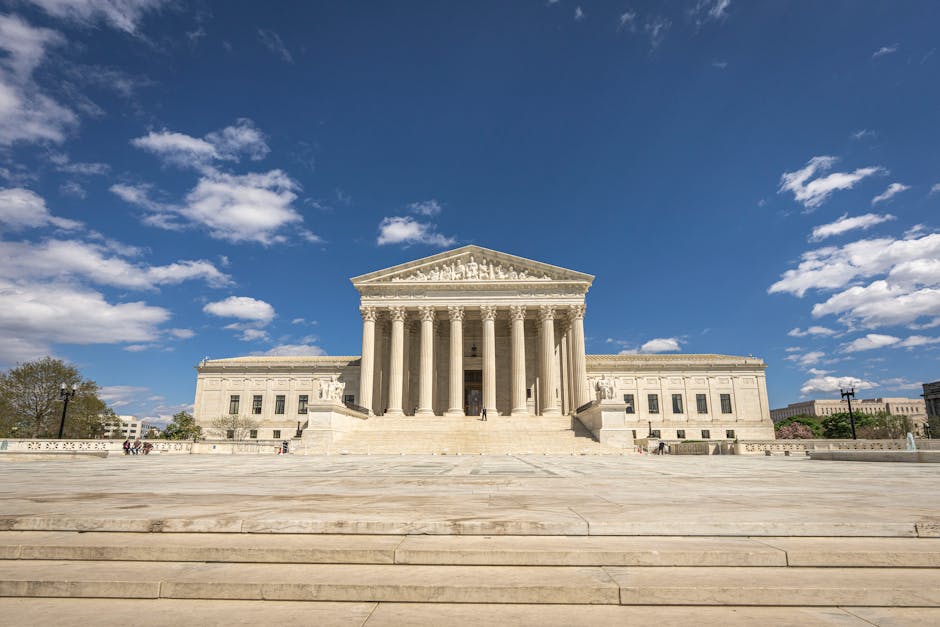
US Supreme Court Callais decision just weakened the Voting Rights Act. What happens next in Mississippi?
By Taylor Vance | Originally published by Mississippi Today
ABERDEEN — A federal judge in Mississippi will soon decide if she should go forward with adopting a new Mississippi Supreme Court district map now that the nation’s highest court has significantly weakened the federal Voting Rights Act.
Mississippi Republican Gov. Tate Reeves, at the same time, wants lawmakers to create new state Supreme Court election maps, in a special session of the Legislature he has ordered to happen May 20, now that the U.S. high court has ruled in a landmark Louisiana v. Callais redistricting case.
Also, politicians in Mississippi and across the South are pondering whether the U.S. Supreme Court ruling will allow them to redraw lines along party affiliation for this year’s midterms now that racial safeguards appear to have been weakened. That might prove a difficult task in Mississippi, since it has already held midterm congressional primaries and its congressional lines already greatly favor the GOP, which holds all but one of six congressional seats.
But Mississippi is set to deal with state Supreme Court districts in the short term.
Senior U.S. District Judge Sharion Aycock held a hearing Tuesday in Aberdeen, weighing whether she should quickly craft a new map for at least some of the state judges to run in possible November special elections or wait for guidance from the nation’s highest court.
“It is a balancing act,” Aycock said.
But now that guidance has arrived.
The U.S. Supreme Court on Wednesday, a day after Aycock’s hearing in northeast Mississippi, struck down Louisiana’s second majority Black congressional district in a decision that could open the door for Republican-led states to eliminate Black and Latino electoral districts that tend to favor Democrats and affect the balance of power in Congress.
“That map is an unconstitutional gerrymander,” Justice Samuel Alito wrote for the six conservatives.
The court’s conservative majority found that the district relied too heavily on race and weakened the landmark voting rights law’s protections against discrimination in redistricting.
But the Mississippi case involves three Mississippi Supreme Court districts and is different from the Louisiana congressional district case, something that Aycock acknowledged during Tuesday’s hearing.
“I do think they’re very different cases,” Aycock told attorneys.
The Mississippi litigation started in April 2022 when the American Civil Liberties Union, the ACLU of Mississippi, the Southern Poverty Law Center and private law firms, on behalf of a group of Black Mississippians, sued the state because they believed Black voters in certain parts of the state couldn’t elect a candidate of their choice.
Aycock ruled in August 2025 that the districts illegally dilute Black strength and needed to be redrawn. She allowed the Legislature to come up with a new map during its 2026 session earlier this year, but it declined to do so.
Aycock justified the ruling by noting that no Black person has ever been elected to the Mississippi Supreme Court without having first obtained an interim appointment from the governor.
But the conservative Mississippi Legislature was unpersuaded. Since the lawmakers didn’t adopt new maps, attorneys were back in court on Tuesday to argue about how the judge should proceed.
The plaintiffs proposed three different redrawn maps for consideration, while state officials asked Aycock not to adopt any map until the U.S. Supreme Court Callais decision
Ari Savitzky is an attorney for the plaintiffs and he argued that Aycock should move forward quickly with adopting a new map to prevent Black votes from being diluted any longer.
“The remedy must end vote dilution by increasing political opportunity for Black voters,” Savitzky said. “That’s the bottom line.”
Bill Cooper, a redistricting expert for the plaintiffs, created the three new maps that Aycock could implement: one called the race-blind plan, another called the least-change plan and a final one called the regional plan.
Cooper testified that he did not use racial demographics to craft any of the proposals. Instead, he used data such as sustained poverty rates in certain counties to create a uniform district.
But Michael Wallace, an outside attorney representing the state, pointed out that a disproportionate number of Black Mississippians are impoverished when compared to white citizens. So he could use poverty as a proxy for racial data.
Wallace also cast doubt that Cooper’s maps could truly be race-neutral because he’s previously done redistricting work in Mississippi.
“Didn’t you tell the court when you testified here before that you’ve done a lot of work here in Mississippi, so you understand the state by race?” Wallace asked.
Mississippi Supreme Court races generally receive less voter participation than other races, but the state’s highest court has ruled on several vital issues in recent years, such as the state’s ballot initiative and allowing the Legislature to give money to private schools.
If Aycock still believes a new map should be implemented after the Callais decision, she could adopt one of the maps the plaintiffs presented, tweak one of the plaintiffs’ maps or employ an outside expert to help her craft a map.
Another complication for the future of the state Supreme Court’s district lines is how Mississippi politicians respond to the Callais decision.
Reeves has ordered lawmakers to return to Jackson in three weeks to redraw the state Supreme Court districts, even though those same lawmakers declined to redraw the districts in response to Aycock’s initial order.
It’s unclear how lawmakers will respond to the Callais case and how Aycock would respond to a potential new map from the Legislature.
She asked attorneys in court if she should tell the Legislature that she preferred they adopt a certain map or if she should wait for the Legislature to act before she adopts a map. The attorneys responded that Aycock has wide latitude to decide how to proceed.
Justin Matheny, an attorney with the Mississippi Attorney General’s Office, told Aycock that she should not adopt a map until after the Callais ruling because the Legislature could choose to adopt a competing plan to her plan, which would then likely prompt a new round of litigation.
We would be here in three or four months or however long it would be and in an even bigger mess that we’re in right now,” Matheny said.
This article was originally published by Mississippi Today and is republished here under a Creative Commons license.
Source: Original Article