What is in the Mississippi Education Reform Bill? County Republicans help pass measure in tight vote
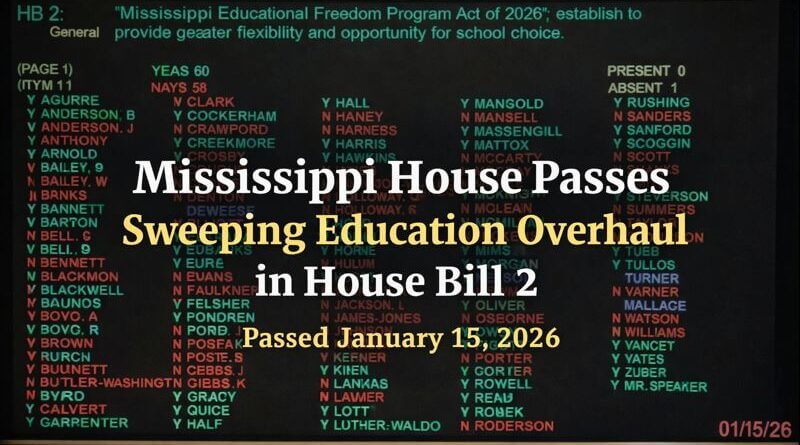
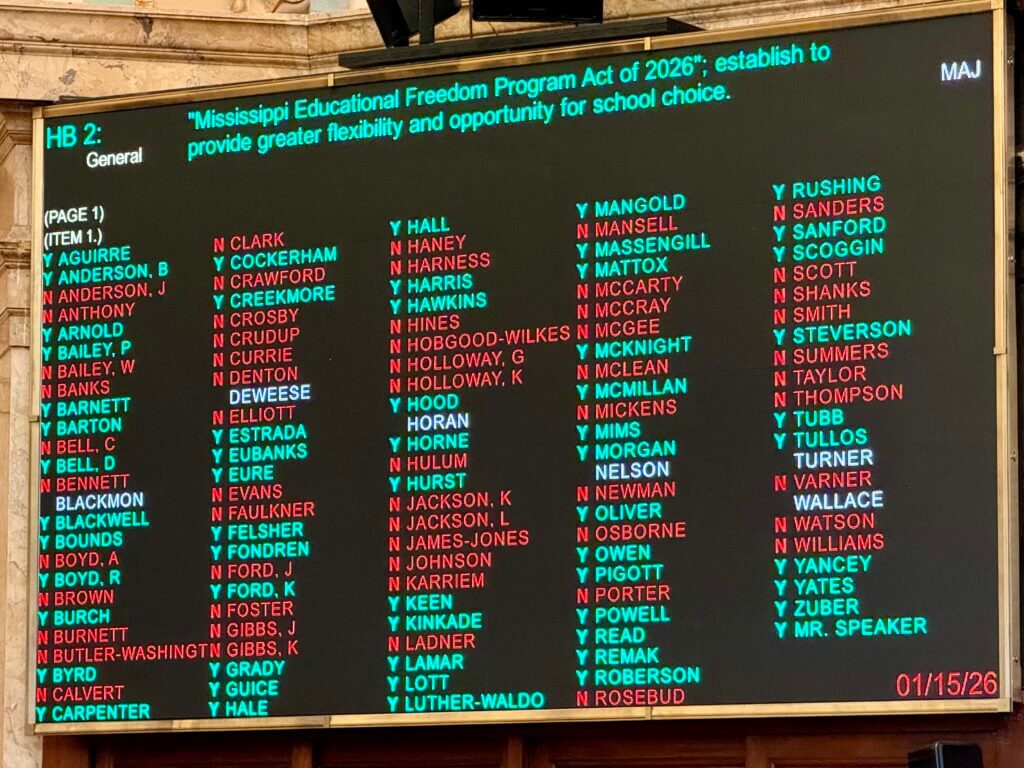
JACKSON, Miss. — A unified front of DeSoto County Republicans proved decisive Thursday as the Mississippi House of Representatives narrowly passed a landmark 553-page education reform bill. The Mississippi Education Freedom Act, or House Bill 2, cleared the chamber by such a slim margin that the shift of a single vote would have resulted in a tie and defeated the measure.
State Rep. Dan Eubanks (R-Walls) watched the final tally closely, noting the high stakes for the delegation. “It was pretty close,” Eubanks said. “If one ‘yes’ had flipped to a ‘no,’ it would have tied and killed the bill. There were about 16 Republicans who voted against it, but our caucus held the line.”
DeSoto Delegation: 7-1 Split
All seven Republican House members representing DeSoto County voted in favor of the bill, providing a critical block of support for the GOP leadership’s agenda. State Rep. Rodney Hall (R-Southaven), who monitored the vote count alongside Eubanks, characterized the victory as a win for local autonomy.
“Mississippi Education Freedom is about restoring opportunity to families, strengthening schools, and believing in the promise of every Mississippi child,” Hall said. “We’ve seen what works through the Mississippi Miracle, and this bill builds on that success by trusting families and communities to lead the way.”
The lone dissenting vote within the county delegation came from State Rep. Hester Jackson-McCray (D-Horn Lake), who stood as the only representative from DeSoto County to oppose the measure.
The legislation combines school choice expansion, public school transfer changes, teacher retirement reforms, curriculum mandates and district consolidation into a single measure that now heads to the Senate for consideration.
House Bill 2 reshapes how Mississippi funds education, where students may attend school, and how teachers retire, while also altering long-standing policies related to testing, literacy and homeschool participation.
State-Funded Education Savings Accounts
At the center of the bill is the creation of the Magnolia Student Account program, a state-funded Education Savings Account (ESA) system that allows families to use public education dollars for private education and other approved educational services.
Under the bill, eligible students will receive an ESA funded at the state’s base student cost, estimated at approximately $7,000 per year. Families may use those funds for private school tuition, tutoring, textbooks, educational therapy or transportation-related educational expenses.
Participation in the ESA program will be capped during its initial rollout. The program begins in the 2027–2028 school year with a limit of 12,500 students. The cap increases annually, reaching 20,000 students by the fourth year.
Eligibility is split evenly. Half of the available slots are reserved for students currently enrolled in public schools, while the remaining half are open to any student, including those already attending private schools. Priority for awards is determined by household income, starting with families at 100% of the Area Median Income, then expanding to 200% and 300%.
The bill also establishes a separate homeschool stipend program. Homeschool families may apply for up to $1,000 annually for educational expenses, funded through a statewide pool capped at $5 million per year.
Teacher Retirement and Workforce Changes
House Bill 2 includes several provisions aimed at addressing teacher shortages and recent changes to retirement benefits under the Public Employees’ Retirement System.
The legislation reverses changes made to Tier 5 of the Public Employees’ Retirement System, restoring full retirement eligibility at 30 years of service rather than 35. The bill also shortens the vesting period from eight years back to four.
Retired teachers are allowed to return to the classroom to fill vacancies without losing retirement benefits. Under the bill, retired educators may draw their full PERS retirement while also earning a full salary, eliminating previous income caps and benefit suspensions.
The measure also raises the minimum annual salary for assistant teachers to $20,000.
Open Enrollment Across District Lines
The bill significantly alters Mississippi’s public school transfer process by expanding open enrollment between districts.
Currently, transfers require approval from both the student’s home district and the receiving district. House Bill 2 removes the sending district’s authority to block a transfer. Under the new system, only the receiving district must approve the transfer, provided it has the capacity to accept the student.
Home School Access to Extracurricular Activities
House Bill 2 incorporates what is commonly referred to as the “Tim Tebow Act,” granting homeschool students legal access to extracurricular activities at their zoned public schools.
Homeschool students may participate in athletics, band, clubs and other extracurricular programs at the public school they would otherwise attend based on residency.
Charter School Limitations
The final version of the bill places new restrictions on where charter schools may open without local approval.
Charter schools may bypass local school board approval only in districts that contain at least one school rated “D” or “F.” Districts without low-performing schools retain greater authority over charter school expansion within their boundaries.
Curriculum, Testing and Accountability Changes
House Bill 2 directs the Mississippi Department of Education to seek a federal waiver to eliminate standardized testing for students in grades 3 through 8. High school testing requirements, including the ACT and subject-area assessments, would remain in place.
The bill expands Mississippi’s literacy “reading gate” policy beyond third grade. Students in grades 4 through 8 would also be required to demonstrate reading proficiency before being promoted to the next grade.
The legislation adds a new high school graduation requirement: a half-credit course in Financial Literacy, beginning with the graduating class of 2031.
Additionally, the bill codifies a requirement for a daily period of silent reflection or prayer at the start of the school day.
Mandatory District Consolidation
House Bill 2 mandates the consolidation of the Hazlehurst City School District and the Copiah County School District. The consolidation must be completed by July 1, 2028.
What Comes Next
Having passed the House, House Bill 2 now moves to the Mississippi Senate, where lawmakers will debate, amend or vote on the measure. If approved by the Senate and signed into law, the legislation would phase in changes over the next several years, reshaping Mississippi’s education system at nearly every level.